≈ 10 months
Review of the environmental authorisation application
The Lithium de France project, deployed in Alsace by Arverne, France’s leading provider of geothermal solutions, aims to accelerate the energy transition by supplying heat to businesses, farmers and local authorities, and by producing geothermal lithium for battery manufacturing. It is a direct response to the challenges of decarbonisation, sovereignty and reindustrialisation, making use of the resources of the Alsace subsurface to build a strategic, local and sustainable industry.
The Durrenbach project builds on the momentum already under way in Schwabwiller, where two wells are currently being drilled under Exclusive Exploration Permits granted by the French State, for the benefit of the region and its residents.
What is it?
The project involves drilling four exploratory wells in Durrenbach (two ‘geothermal doublets’). The aim is to analyse and confirm the flow rate, temperature and lithium content of the geothermal water found deep underground. These wells target geothermal water that is unfit for consumption and lies far below the groundwater aquifers that supply drinking water.
How it works?
The geothermal water is brought up to the surface. Its heat and lithium are extracted, and the water is then fully reinjected into its original natural environment.
Where is the site?
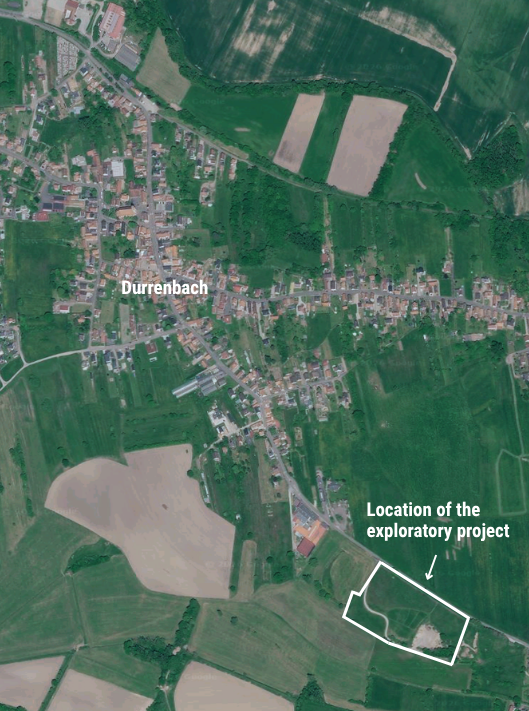
The site is located in the municipality of Durrenbach, on the Route de Walbourg, at the former recycling centre.
Why this site?
The site was selected following several geological exploration campaigns carried out in the Upper Rhine Graben, combining analysis of existing data with 3D subsurface imaging. The choice meets several criteria: proximity to the targeted geothermal reservoir, distance from protected natural areas, and site accessibility.

Once the DREAL (Regional Directorate for the Environment, Planning and Housing) and the Bas-Rhin Prefecture have checked that the application is compliant, it will be reviewed by the relevant State departments. As part of this review, a public inquiry will be held, giving everyone the opportunity to express their views on the project.

The public inquiry is a regulatory procedure set out in the French Environmental Code, with a twofold objective: to inform the public and to gather their comments. It will be conducted under the authority of an independent inquiry commissioner appointed by the Administrative Court. At the end of the inquiry, the commissioner will draft a report summarising the public’s comments, then submit reasoned conclusions to the Prefect of the Bas-Rhin, who will decide whether or not to authorise the works to begin.

Come and talk to the Lithium de France team in the car park of Durrenbach town hall:
*Subject to obtaining the necessary authorisations
Review of the environmental authorisation application
Site preparation works
Drilling of the exploratory wells
Measurements to characterise the subsurface and geothermal waters
If the measurements are not conclusive regarding the heat potential and lithium concentration of the geothermal brines, Lithium de France will close the wells in line with industry best practice and restore the works area.
The drilling rig is electrically powered and hydraulically operated. It stands 52 metres high. It will be on site only during the drilling phase and will be fully dismantled once the works are complete. The worksite footprint is limited to two hectares. The site will be fenced and secured for the entire duration of the works. To preserve local residents’ quality of life, site lighting will be directed towards the worksite. Acoustic studies will be carried out before and during operations to measure, monitor and control the noise impact of the worksite.
Protecting water resources is a priority. A triple layer of casing and cement is installed in the well, ensuring complete isolation between the groundwater aquifers, which supply drinking water, and the targeted deep geothermal waters, which are unfit for consumption. A network of three piezometers will be installed on site to monitor the condition of the groundwater before, during and after the works.
An impact assessment was carried out over four full seasons. Its conclusions confirm that there are no major environmental issues on the site.
The Upper Rhine Graben is a region with naturally occurring low to moderate seismic activity linked to its geological history. As with any deep geothermal project, the project involves permanent monitoring of subsurface movements. To this end, a network of seismic monitoring stations will be deployed around the site six months before drilling begins, ensuring continuous 24/7 monitoring under the ongoing supervision of the DREAL. If any variation is detected, immediate adjustments will be made where necessary, following strict protocols that are a condition of the drilling authorisation. All our operations are carried out in accordance with the Good Practice Guide for Deep Geothermal Energy published by INERIS (French National Institute for Industrial Environment and Risks) and BRGM (French Geological Survey), as well as the provisions of the French Mining Code.
Since 2020, Lithium de France has been working to create a new industry that combines geothermal heat and lithium. The unique geology of the Upper Rhine Graben and Alsace, whose subsurface contains lithium-rich geothermal waters, offers a rare opportunity to meet a threefold objective. This is in line with the decarbonisation and independence strategy pursued at national and European level, while also driving the energy transition locally :
Produce renewable, continuous, low-carbon heat at a stable cost for local use, benefiting the region, through heat networks serving local authorities, farms and industrial companies.
Restore energy sovereignty through a short supply chain for battery-grade lithium, from extraction to refining.
Contribute to France’s reindustrialisation and local employment: supporting and reshoring industrial activities with local, competitive, low-carbon energy, as well as lithium for French gigafactories.
Photo credits: Lithium de France, Durrenbach town hall